7 Best AI Writing Assistants for Small Business Marketing (2026)

Content marketing works, but writing it consistently is one of the first things small business owners let slide when they get busy. AI writing assistants won't replace a skilled copywriter, but they meaningfully cut the time it takes to draft blog posts, product descriptions, ad copy, and social captions — especially useful when marketing is one of six jobs you're doing this week.
Why Small Businesses Are Turning to AI Writing Tools
Content marketing works, but writing it consistently is one of the first things small business owners let slide when they get busy. AI writing assistants won't replace a skilled copywriter, but they meaningfully cut the time it takes to draft blog posts, product descriptions, ad copy, and social captions — especially useful when marketing is one of six jobs you're doing this week.
What to Look for in an AI Writing Assistant
The best tools for small business use aren't necessarily the ones with the flashiest demo — they're the ones that let you set a consistent brand voice, integrate with the channels you actually publish to, and produce a first draft you can edit quickly rather than one you have to rewrite from scratch.
The 7 Best AI Writing Tools
Jasper — Best for Marketing Teams
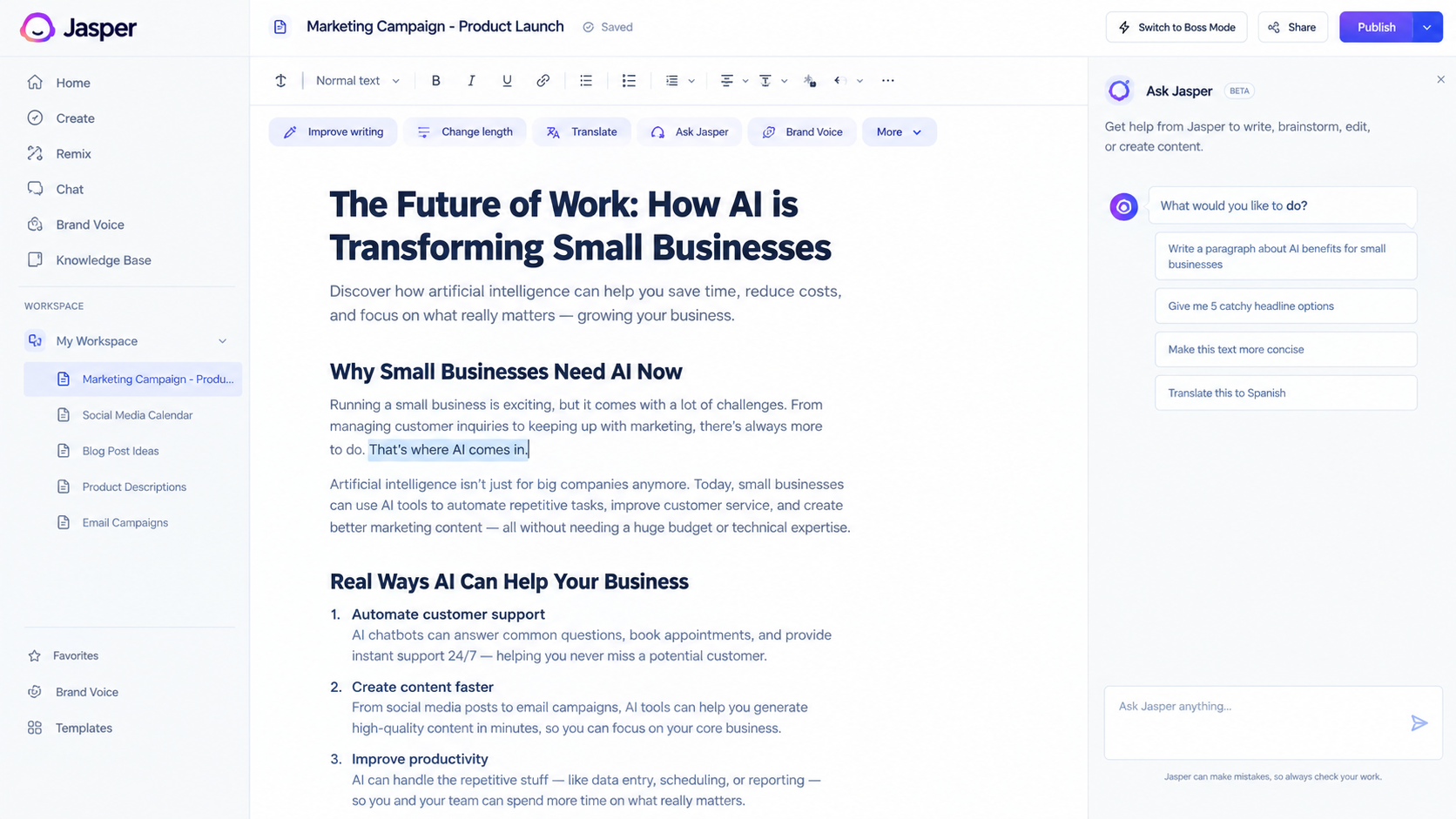
Jasper is built specifically around marketing use cases: blog posts, ad copy, email campaigns, and social content, with brand voice settings that keep output consistent across a team of multiple writers. It's priced at a premium compared to general-purpose AI tools, which makes the most sense if content marketing is a core part of your business rather than an occasional task.
Claude — Best for Long-Form, Nuanced Writing
For businesses writing detailed guides, thoughtful email newsletters, or anything requiring nuance and accuracy over pure marketing punchiness, Claude (Anthropic's AI assistant) consistently produces more coherent long-form output with fewer factual slip-ups than tools purpose-built for short marketing copy. It's not marketed specifically at small business marketing the way Jasper is, so you'll be writing your own prompts rather than using pre-built marketing templates, but the writing quality for longer pieces is a genuine strength.
Screenshot pendiente: Claude
Captura de pantalla pendiente
Copy.ai — Best for Ad Copy and Short-Form
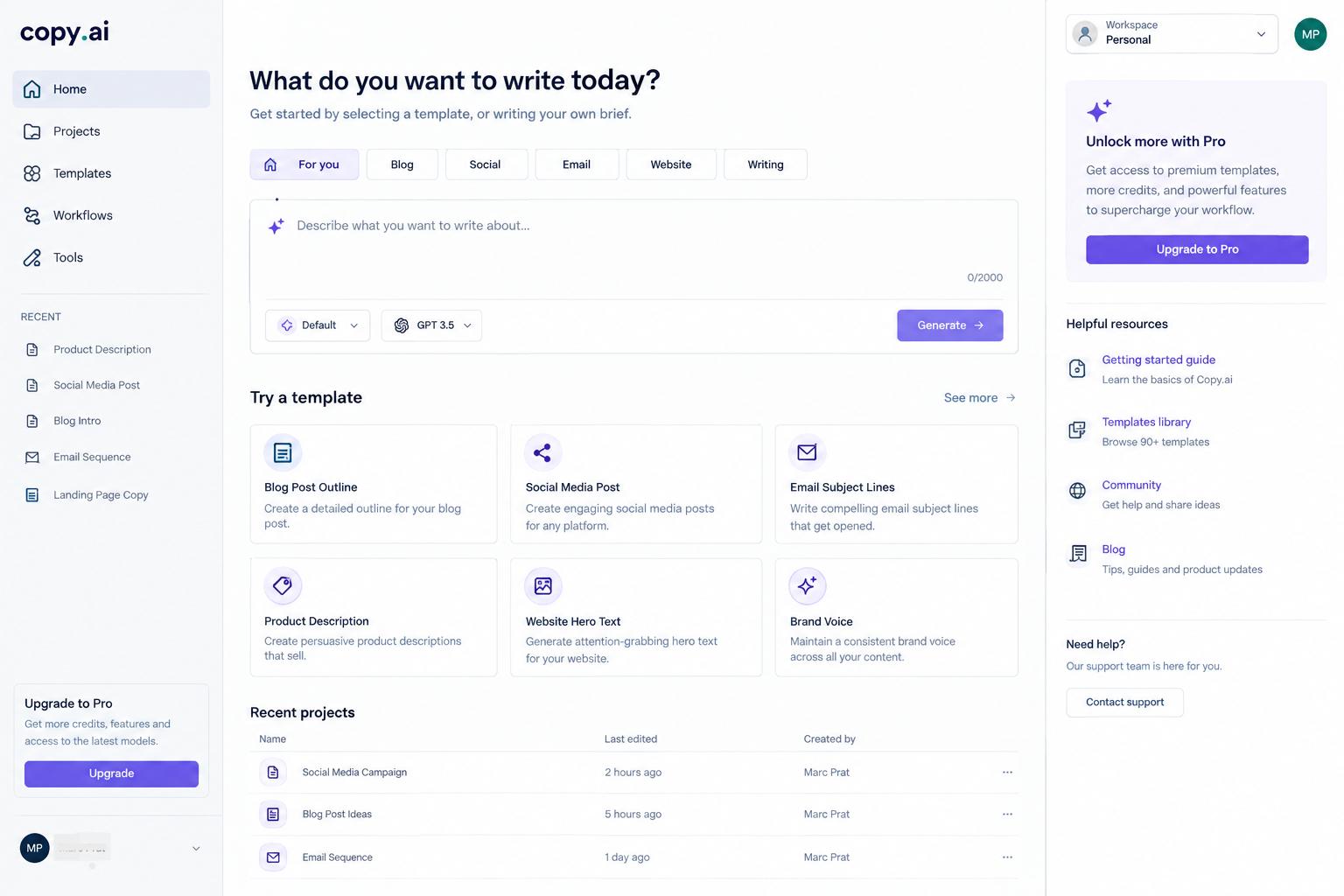
Copy.ai leans into short-form output: headlines, ad variations, product descriptions, and social captions, with a large library of templates aimed at quickly generating multiple variations to test. It's less suited to long-form content like full blog posts, where the output tends to need more restructuring.
Grammarly Business — Best for Polishing, Not Generating
Grammarly's AI features are strongest at improving writing you or your team already drafted — tightening sentences, adjusting tone, fixing clarity issues — rather than generating content from scratch. It's a good complement to any of the generation-focused tools above rather than a replacement for them.
Writesonic — Best for SEO Blog Content
Writesonic bundles AI writing with basic SEO tools like keyword suggestions and competitor content analysis, aimed at businesses whose main content goal is ranking in Google search. It's a reasonable one-stop option if you don't already have a separate SEO tool and want blog content generation and optimization in the same place.
Anyword — Best for Performance Prediction
Anyword's standout feature is a predictive performance score that estimates how well a piece of copy is likely to perform based on the audience and platform you specify, which is useful for businesses running paid ad campaigns and wanting to test copy variations before spending ad budget. It's a more specialized tool than the others on this list and less useful if you're not running paid advertising.
Rytr — Best Budget Pick
Rytr covers most of the same use cases as the tools above — blog posts, emails, ad copy, social captions — at a noticeably lower price point, with a corresponding drop in output sophistication and template variety. For a very early-stage business testing whether AI writing tools are worth adopting at all before committing to a pricier tool, it's a reasonable low-risk starting point.
How to Use AI Writing Tools Without Sounding Generic
The biggest complaint about AI-generated marketing content is that it all starts to sound the same. The fix isn't avoiding AI tools — it's feeding them specific inputs: your actual customer questions, real product details, and examples of your existing brand voice, rather than generic one-line prompts. Every tool above performs meaningfully better with a detailed prompt and worse with a lazy one.
Frequently Asked Questions
Will Google penalize AI-generated content?
Google has stated it evaluates content on quality and helpfulness, not whether it was written with AI assistance. Thin, unedited AI output tends to perform poorly for the same reason thin human-written content does — it doesn't hold up against Google's helpful content standards.
Can these tools write in my brand voice?
Jasper, Copy.ai, and Anyword all offer brand voice settings that improve consistency after some initial setup; Claude and Rytr rely more on how detailed your own prompts are.
Do I still need a human editor?
Yes — every tool on this list produces a draft that benefits from a human review pass for accuracy, tone, and factual claims specific to your business.

